
 中文
中文

High-frequency inverters are switching devices used in industrial applications. What is the working principle of a high-frequency inverter? This equipment employs program logic for control. High-frequency inverters can be utilized in the telecommunications industry as a type of switching device for computer rooms. This power supply can be applied in the solar energy and power generation sectors. It is a switching power supply device that uses data cables for output and is highly safe. This article primarily introduces the working principle of high-frequency inverters and the differences between high-frequency and low-frequency inverters. Follow Baoweite Power's editor for a detailed understanding.
Working Principle of High-Frequency Inverters
A high-frequency inverter is a DC-to-AC transformer that essentially performs voltage inversion, similar to a converter. The operating principle of a high-frequency inverter involves two components: the converter transforms the AC voltage from the power grid into a stable 12V DC output, while the inverter converts the 12V DC output from the adapter into high-frequency, high-voltage AC power. Both components utilize the widely adopted Pulse Width Modulation (PWM) technology. At their core lies a PWM integrated controller: the Adapter uses the UC3842, while the inverter employs the TL5001 chip. The TL5001 operates within a 3.6–40V voltage range and incorporates an error amplifier, regulator, oscillator, PWM generator with dead-time control, low-voltage protection circuit, and short-circuit protection circuit.
1. Input Section: The input section comprises three signals: 12V DC input (VIN), operating enable voltage (ENB), and panel current control signal (DIM). VIN is supplied by the adapter, while ENB voltage is provided by the MCU on the motherboard, with values of either 0V or 3V. When ENB=0, the inverter remains inactive. while at ENB=3V, the inverter operates normally. The DIM voltage is supplied by the mainboard, varying between 0~5V. Different DIM values are reflected to the feedback terminal of the PWM controller, causing the inverter to supply varying currents to the load. A smaller DIM value results in a larger output current from the inverter.
2. Voltage Initiation Circuit: When ENB is high, it outputs high voltage to ignite the backlight lamp of the panel.
3. PWM Controller: Comprises the following functional components: internal reference voltage, error amplifier, oscillator and PWM, overvoltage protection, undervoltage protection, short-circuit protection, and output transistor.
4. DC-to-DC Conversion: A voltage conversion circuit formed by MOSFET switches and an energy storage inductor. Input pulses are amplified by a push-pull amplifier to drive the MOSFETs in switching operation, causing the DC voltage to charge and discharge the inductor. This generates an AC voltage at the other end of the inductor.
5. LC Oscillation and Output Circuit: Ensures the 1600V voltage required for lamp ignition and reduces the voltage to 800V after ignition.
6. Output Voltage Feedback: Monitors the load's operating voltage to stabilize the inverter's output voltage.
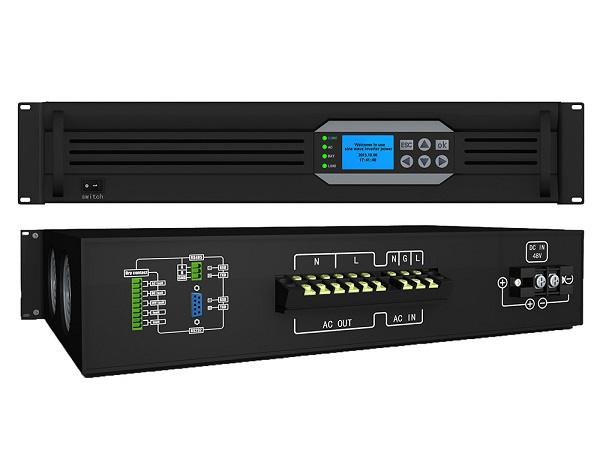
Classification of High-Frequency Inverters
1. Square Wave Inverters
Square wave inverters produce an output voltage waveform shaped like a square wave. While the inverter circuits used in these devices vary, they share the common characteristics of relatively simple circuitry and minimal power switch transistors. Their rated power typically ranges from hundreds to thousands of watts. The advantages of square wave inverters include: straightforward circuitry, low cost, and ease of maintenance. Disadvantages include the presence of numerous high-order harmonics in the square wave voltage, which cause additional losses in loads with iron-core inductors or transformers and interfere with radios and certain communication equipment. Furthermore, these inverters suffer from narrow voltage regulation ranges, inadequate protection features, and relatively high noise levels.
2. Step Wave Inverters
These inverters produce a step wave AC voltage output. Various circuit designs achieve step wave output, with the number of steps in the output waveform varying significantly. The advantages of step wave inverters include a markedly improved output waveform compared to square waves, reduced higher-order harmonic content, and the ability to achieve a quasi-sinusoidal waveform when the number of steps exceeds 17. When employing transformerless output, the overall efficiency is very high. The drawback is that the staircase wave superposition circuit requires a large number of power switching transistors. Some circuit configurations also demand multiple DC power inputs. This complicates the grouping and wiring of solar cell arrays as well as the balanced charging of batteries. Additionally, the staircase wave voltage still causes some high-frequency interference to radios and certain communication equipment.
High-Frequency Inverter Features
1. Wide input voltage range, high voltage regulation accuracy, and strong environmental adaptability;
2. Utilizes dedicated microprocessor control and digital technology, leading globally;
3. Pure sine wave output with excellent electrical performance metrics;
4. LED + LCD display provides a user-friendly interface, intuitively showing inverter status, load conditions, environmental parameters, and operational data;
5. Flexible selection between bypass priority or inverter priority modes;
6. Input/output electrical isolation withstanding computer startup surge impacts;
7. High-efficiency inversion with minimal no-load losses;
8. Advanced manufacturing processes yielding aesthetically pleasing designs;
9. Comprehensive protection: input overvoltage/undervoltage/reverse polarity; output overload/short circuit; utility bypass high/low voltage;
10. Capable of AC startup without DC input;
11. Fully automated protection, suitable for unattended stations.
Differences Between High-Frequency and Low-Frequency Inverters
1. According to the frequency spectrum classification established by the Institute of Electrical and Electronics Engineers (IEEE), low-frequency ranges from 30 to 300 kHz, medium-frequency from 300 to 3000 kHz, and high-frequency from 3 to 30 MHz. Frequencies between 30 and 300 MHz are classified as very high frequency (VHF), while those between 300 and 1000 MHz are ultra-high frequency (UHF). Compared to low-frequency signals, high-frequency signals change rapidly and exhibit abrupt transitions; low-frequency signals change slowly and have smooth waveforms.
2. Power supply and signals are fundamentally different. Power boards typically provide voltage at either 0 Hz (DC power) or 50 Hz (AC power). Signals can be classified as high-frequency, low-frequency, or other frequencies. Power boards, however, are purely for power delivery and operate at very low frequencies—if anything, they could be considered low-frequency.
3. The primary advantages of high-frequency inverters are lighter weight, smaller size, lower standby power consumption, and higher efficiency (relatively more energy-efficient). The disadvantage is that they are less shock-resistant than industrial frequency inverters (i.e., the low-frequency type you mentioned) and may not be able to power appliances like food mixers or hand drills. The disadvantage of low-frequency inverters is that they are heavier, larger, and may be slightly more expensive, with slightly higher inherent losses (somewhat more power-consuming). The advantage is that they are more durable and better suited for powering appliances with impact loads.
The above information is provided by Baoweite Power www.bwitt.com.cn. For high-frequency pure sine wave power supplies, feel free to contact our online customer service anytime!
