
 中文
中文

What is an inverter power supply?
What is an inverter power supply?
An inverter power supply is a device used for power conversion in electrical applications. It is a type of switching equipment employed in industrial settings, though it is not commonly encountered in everyday life. Controlled by programmable logic, it is primarily utilized in industrial environments and large-scale machinery.
Principle of Inversion:
An inverter power supply converts direct current (DC) into alternating current (AC). Typically, thyristor circuits are used to transform DC into AC. This process, the inverse of rectification, is defined as inversion. Converting AC to DC is called rectification, while converting DC to AC is inversion.
What are the functions of an inverter power supply?
Inverter power supplies are used in the telecommunications industry as switching equipment in computer rooms. Inverter power supplies can be used in the solar energy and power generation industries. They are switch-mode power supply devices that utilize data cables for output. An inverter power supply is a device that converts DC electrical energy into AC electrical energy,
providing power for AC loads and is highly safe. In layman's terms: an inverter is a switching device that can generate electricity for an appliance. This type of power supply requires recharging after discharging. Below, let's learn more about inverter power supplies.
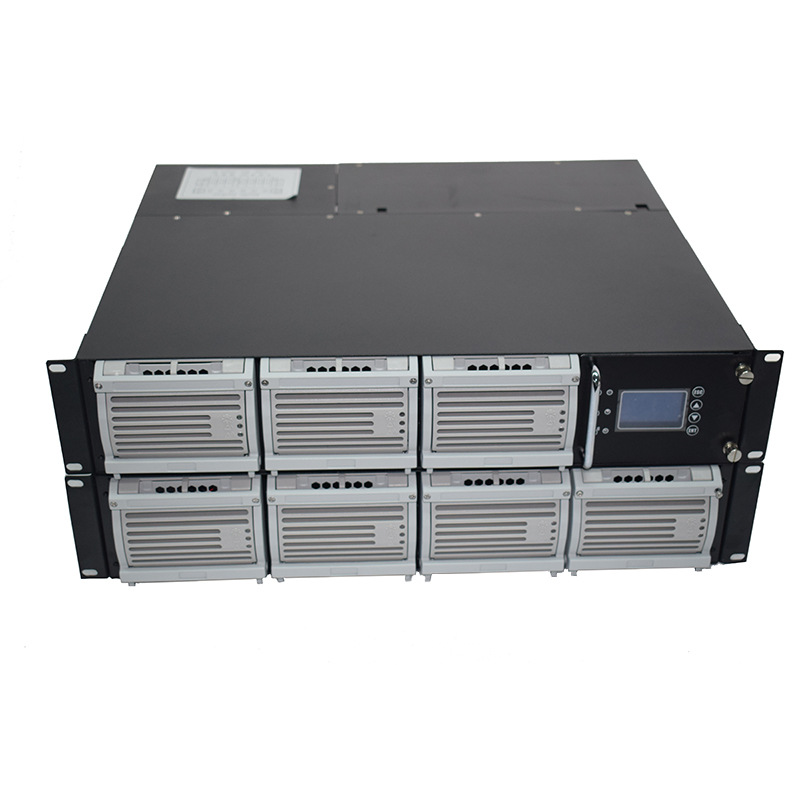
An inverter power supply is a power source that converts direct current (DC) into alternating current (AC). Typically, thyristor circuits are used to transform DC into AC. This process, which is the inverse of rectification, is defined as inversion.
For example: In thyristor-controlled electric locomotives, during downhill runs, the DC motor operates as a generator for braking. The locomotive's potential energy is converted into electrical energy and fed back into the AC grid. Similarly, to rapidly brake a running DC motor, it can be operated as a generator,
converting the motor's kinetic energy into electrical energy and feeding it back into the grid. Thyristor: Short for thyristor, also known as a silicon-controlled rectifier (SCR), formerly abbreviated as SCR; In 1957, General Electric Company in the United States developed the world's first thyristor product and commercialized it in 1958.
Thyristors feature a PNPN four-layer semiconductor structure with three terminals: anode, cathode, and gate. Possessing characteristics of silicon rectifier devices, thyristors operate under high-voltage, high-current conditions with controllable operation. They are widely used in controllable rectification, AC voltage regulation,
contactless electronic switching, inversion, frequency conversion, and other electronic circuits.
The inverter power supply converts grid AC voltage into stable 12V DC output, while the inverter transforms the adapter's 12V DC into high-frequency, high-voltage AC. Both components employ widely used Pulse Width Modulation (PWM) technology.
The core component of both is a PWM integrated controller: the adapter uses the UC3842, while the inverter employs the TL5001 chip. The TL5001 operates within a voltage range of 3.6–40V and incorporates an error amplifier, a regulator, an oscillator,
a PWM generator with dead-time control, a low-voltage protection circuit, and a short-circuit protection circuit.
Features of Inverter Power Supplies
1. High conversion efficiency and rapid startup;
2. Superior safety performance: Features five protection functions—short circuit, overload, over/under voltage, and over-temperature;
3. Excellent physical properties: Constructed with an all-aluminum housing for superior heat dissipation. Surface undergoes hard anodizing for enhanced abrasion resistance and tolerance to moderate external impacts or compression;
4. Strong load adaptability and stability;
