
 中文
中文

We often hear people talk about grid-connected and off-grid systems. So what exactly are grid-connected and off-grid systems? What's the relationship between them, and how can we distinguish them? Let Baoweite explain in detail:
What is Grid-Connected?
Grid-connected means your power generation system is linked to the national grid, while off-grid means your system operates independently of the national grid.
Grid-connected systems must connect to the national grid. This integrates solar power generation, home electricity, and the public grid into one network. Such systems rely on the existing grid to function. Their main advantage is eliminating the need for battery storage, significantly reducing costs. However, grid-connected systems have a drawback: when the public grid experiences an outage, the solar PV generation also ceases to function. Therefore, if you aim to reduce electricity costs and prioritize convenience, a grid-connected power generation system is a viable option. This remains the most popular installation method today.
What is Off-Grid?
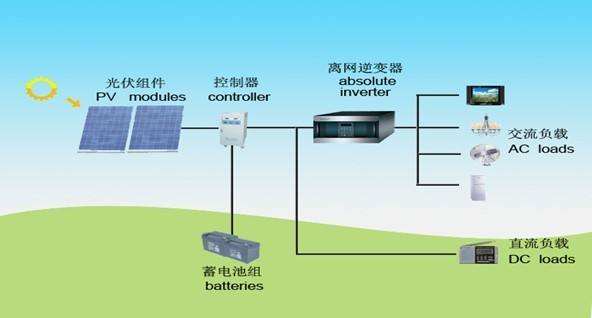
Off-grid, also known as an independent photovoltaic power generation system, is a self-contained system that operates independently of the utility grid. It primarily consists of solar panels, energy storage batteries, charge/discharge controllers, inverters, and other components. For households in areas without grid access or prone to frequent power outages, it offers significant practicality. Particularly for addressing lighting needs during blackouts, DC energy-saving lamps can be employed, proving highly practical.
Therefore, off-grid power systems are specifically designed for use in locations without grid access or prone to frequent power outages.
How to distinguish between grid-connected and off-grid systems?
In essence, an off-grid power system operates independently without relying on the national grid. Compared to grid-connected systems, it incorporates an additional storage battery to store electricity. Consequently, off-grid systems involve higher installation costs and are ineligible for national power generation subsidies. They are commonly used in remote, grid-isolated locations like islands, fishing boats, and outdoor farming bases where power supply is inconvenient. They also serve as emergency power equipment in areas prone to frequent outages, such as solar street lights.
Grid-connected systems qualify for national power generation subsidies. From a long-term investment perspective, installing a grid-connected power generation system can extend the system's lifespan to over 25 years.
Many people wonder: Is there a hybrid photovoltaic power generation system that combines grid-connected and off-grid capabilities?
The answer is yes, absolutely. However, the production and manufacturing costs are significantly higher. Not only must batteries be installed, but also an integrated grid-connected/off-grid unit to switch between the two power generation modes. Shenzhen Baoweite Power's high-frequency inverter-controller integrated solar power system employs this combined grid-connected/off-grid generation. It can supply power normally whether the grid is down or there is no sunlight.
Product Details (
NM-II PLUS Series High-Frequency Inverter-Controller Integrated Unit
)
The above industry insights are provided by Baoweite Power (www.bwitt.com.cn). For inquiries about high-frequency pure power supplies, feel free to contact our online customer service anytime!
